Thinking about adding an ADU in Poway? You are not alone. For many homeowners and small investors, an accessory dwelling unit can create flexible living space, support multigenerational needs, or open the door to rental income, but the real question is whether your specific property can support it. In this guide, you will learn what makes Poway properties promising for ADUs, what local rules matter most, and how to evaluate your lot with a clear, practical mindset. Let’s dive in.
Why ADUs make sense in Poway
Poway stands out because many of its residential areas are low density. The city’s housing analysis shows a range of zoning that includes larger lots, from one-acre areas to neighborhoods with 20,000, 15,000, 10,000, and 4,500 square foot minimums, depending on the zone.
That extra space matters. Poway’s housing analysis also found that more than 90% of recent ADU construction happened in lower-density zones, where owners had more room to fit a second or even third unit.
At the same time, lot size by itself is not the deciding factor. California ADU law says local ordinances generally cannot impose minimum lot size requirements for ADUs and JADUs, so the better question is whether your property can handle the real-world constraints that come with building.
What really determines ADU potential
In Poway, ADU feasibility usually comes down to layout, access, safety, and budget. A large lot can still be challenging if the building area is limited by setbacks, slope, existing structures, or utility issues.
For most properties, you will want to look closely at:
- Side and rear setback room
- Distance from the main house and other structures
- Parking setup
- Fire safety requirements
- Utility connections and capacity
- Whether an existing garage or interior space can be converted
This is why two homes with similar lot sizes can have very different ADU potential. One may have a deep rear yard and a simple driveway layout, while the other may be constrained by slope, wildfire considerations, or building placement.
Poway lot features that can help
Deep rear yards and wide side yards
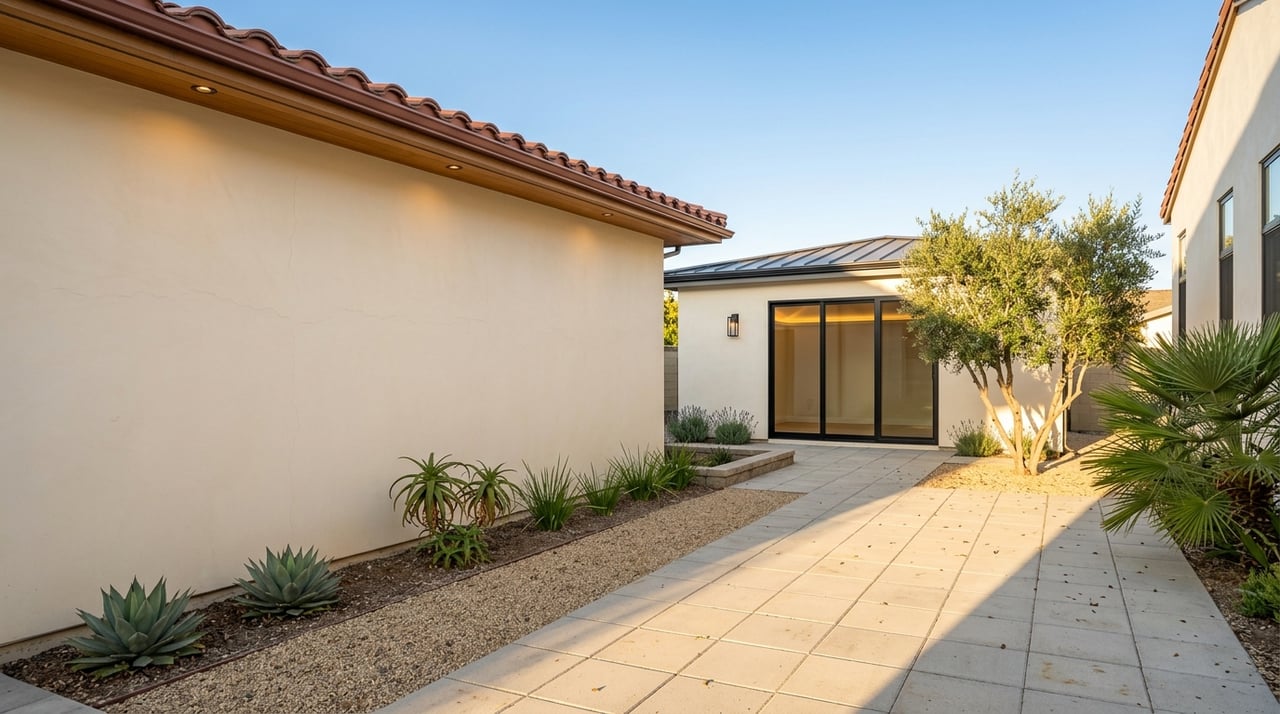
Properties with deeper backyards or wider side-yard space are often easier to evaluate for a detached ADU. State law and Poway’s rules both focus heavily on side and rear setbacks, not just acreage.
For new detached ADUs, side and rear setbacks generally cannot exceed four feet. That means a usable building envelope can sometimes exist even on a lot that does not look huge at first glance.
Existing garage conversions
A garage conversion can be one of the most practical ADU paths in Poway. Both state law and the city’s ADU handout say replacement parking is not required when a garage or carport is converted into an ADU.
That can simplify planning and reduce the amount of site reconfiguration you need. If your property already has a detached garage or underused accessory structure, it may be worth a closer look.
Interior and attached options
Not every ADU project needs to start with new construction. Attached ADUs and interior conversions can be appealing if you want to create livable space with less disruption to the yard or exterior footprint.
Poway also allows junior accessory dwelling units, or JADUs. A JADU must be attached and located within a single-family residence, and it can be up to 500 square feet.
Common reasons Poway owners add ADUs
Multigenerational living
ADUs can be a practical fit if you want to keep family close while preserving privacy. California law recognizes ADUs as a housing option for family members, elderly residents, in-home care providers, students, and people with disabilities.
In Poway, that often translates into space for aging parents, adult children returning home, or caregiving support. If your household needs flexibility over time, an ADU can serve different purposes as life changes.
Long-term rental income
An ADU can also create income potential. California law allows an ADU to be rented separately from the main residence, though it cannot be sold separately.
Poway’s local rules add an important detail: rental terms must be longer than 30 days. That makes ADUs in Poway better suited for long-term or mid-term occupancy rather than short-term lodging.
Flexible work or guest space
Some owners start with a practical need that is not purely residential. You may want space for a home office today, then use that same area later for family housing or a rental unit.
That kind of flexibility is part of what makes ADUs appealing. In the right setup, the same improvement can support your current lifestyle and your long-term property goals.
Key Poway rules to know
Setbacks and building placement
Poway’s ADU guidance says setbacks are generally based on the underlying zone, but side and rear setbacks may be reduced to four feet. State law follows the same basic framework for new detached ADUs.
Poway also says a detached ADU must be at least 10 feet from other structures. That spacing requirement can affect where the unit fits, especially if your lot already has a pool, workshop, or detached garage.
Design compatibility
Poway expects detached ADUs to be similar and compatible with the main residence. The city’s handout references exterior color, architectural style, window treatments, siding, and roof materials.
That does not mean the ADU has to be a perfect match. It does mean the design should feel cohesive with the existing home.
Parking rules
Parking is often more flexible than owners expect. State law says ADU parking cannot exceed one space per ADU or per bedroom, whichever is less, and tandem parking on a driveway may be allowed.
Poway’s handout is consistent with that approach and also confirms that no replacement parking is required for garage or carport conversions. Depending on the property, parking may be less of a hurdle than setbacks or fire review.
Size limits
State law sets important size boundaries. Detached ADUs are capped at 1,200 square feet, attached ADUs are capped at 50% of the existing primary dwelling, and JADUs may not exceed 500 square feet.
Those numbers give you a useful starting point, but your actual buildable size will still depend on site conditions and local review.
Fire safety is a major Poway factor
This is where Poway is different from many other markets. The city says more than 90% of Poway’s geography is in a Fire Hazard Severity Zone, and it has its own Very High Fire Hazard Area map because of local wildfire conditions.
If your property is near slopes, chaparral, or a wildland edge, fire review should be part of your planning from the start. Waiting until late in the process can create delays, redesign costs, or unrealistic expectations.
Poway’s ADU handout also notes a four-foot interior side and rear setback requirement within a Very High Fire Hazard Area for certain additions. It also says sprinklers are required only if they are already required for the single-family residence.
Beyond permitting, defensible space and home hardening matter in this market. If you are evaluating ADU potential on a Poway lot, fire-safe design is not just a detail. It is central to the conversation.
Fees, utilities, and permit planning
Budget planning is just as important as site planning. Under state guidance, impact fees cannot be charged on ADUs under 750 square feet or on JADUs.
Poway’s handout says impact and stormwater fees are required for ADUs that are 750 square feet or larger, and impact fees are 50% of development impact fees. That means the size of the unit can affect not only design but also total project cost.
Utilities matter too. Water and sewer capacity can influence what is realistic for a site, so this is not something to leave until the end.
For the process itself, Poway says applicants should work with a designer or architect to prepare plans, submit electronic plans through the city’s online services portal, and respond to plan-check corrections before permit issuance. For many residential projects, a qualified drafter, building designer, architect, or engineer will be needed.
A simple way to assess your property
If you are trying to decide whether an ADU is worth exploring, start with a practical checklist. You do not need every answer on day one, but you do need a realistic view of the lot.
Ask yourself:
- Do you have usable side-yard or rear-yard space?
- Is there an existing garage or accessory structure that could be converted?
- Can the ADU sit at least 10 feet from other structures if detached?
- Does the site appear constrained by slope or wildfire exposure?
- Would a smaller attached ADU or JADU make more sense than a detached unit?
- Are you planning for long-term use, family housing, or rental income over 30 days?
- Have you considered potential fees if the unit will be 750 square feet or larger?
This kind of early screening can save time and help you focus on options that match the property.
Why ADU potential matters in real estate
If you own a home in Poway, ADU potential can shape how you think about the property’s future. It may influence whether you hold, improve, rent, or eventually sell.
For buyers, a property with realistic ADU potential can offer more flexibility than the house alone suggests. For sellers, understanding that potential can help you market the property more clearly and attract interest from buyers looking for multigenerational space or long-term rental options.
The key is to stay grounded in what the lot can actually support. In Poway, the most promising ADU opportunities usually come from the right combination of space, layout, fire-safe planning, and a workable budget.
If you are weighing a Poway property for ADU potential, or wondering how that potential may affect value and marketability, Evan Wagley can help you evaluate the property with a local, process-driven perspective.
FAQs
Does a Poway property need a minimum lot size for an ADU?
- California ADU law says local ordinances generally may not impose minimum lot size requirements, but the property still needs to accommodate setbacks, access, parking, and utility needs.
Can you convert a garage into an ADU in Poway?
- Yes. Poway and state law both say replacement parking is not required when a garage or carport is converted into an ADU.
How big can an ADU be on a Poway property?
- Detached ADUs can be up to 1,200 square feet, attached ADUs can be up to 50% of the existing primary home, and JADUs can be up to 500 square feet.
Can you rent out an ADU in Poway?
- Yes. State law allows separate rental of an ADU, and Poway says rental terms must be longer than 30 days.
Do you have to live on site if you build an ADU in Poway?
- For an ADU, Poway says there is no occupancy requirement. For a JADU, either the main residence or the JADU must be owner occupied at all times.